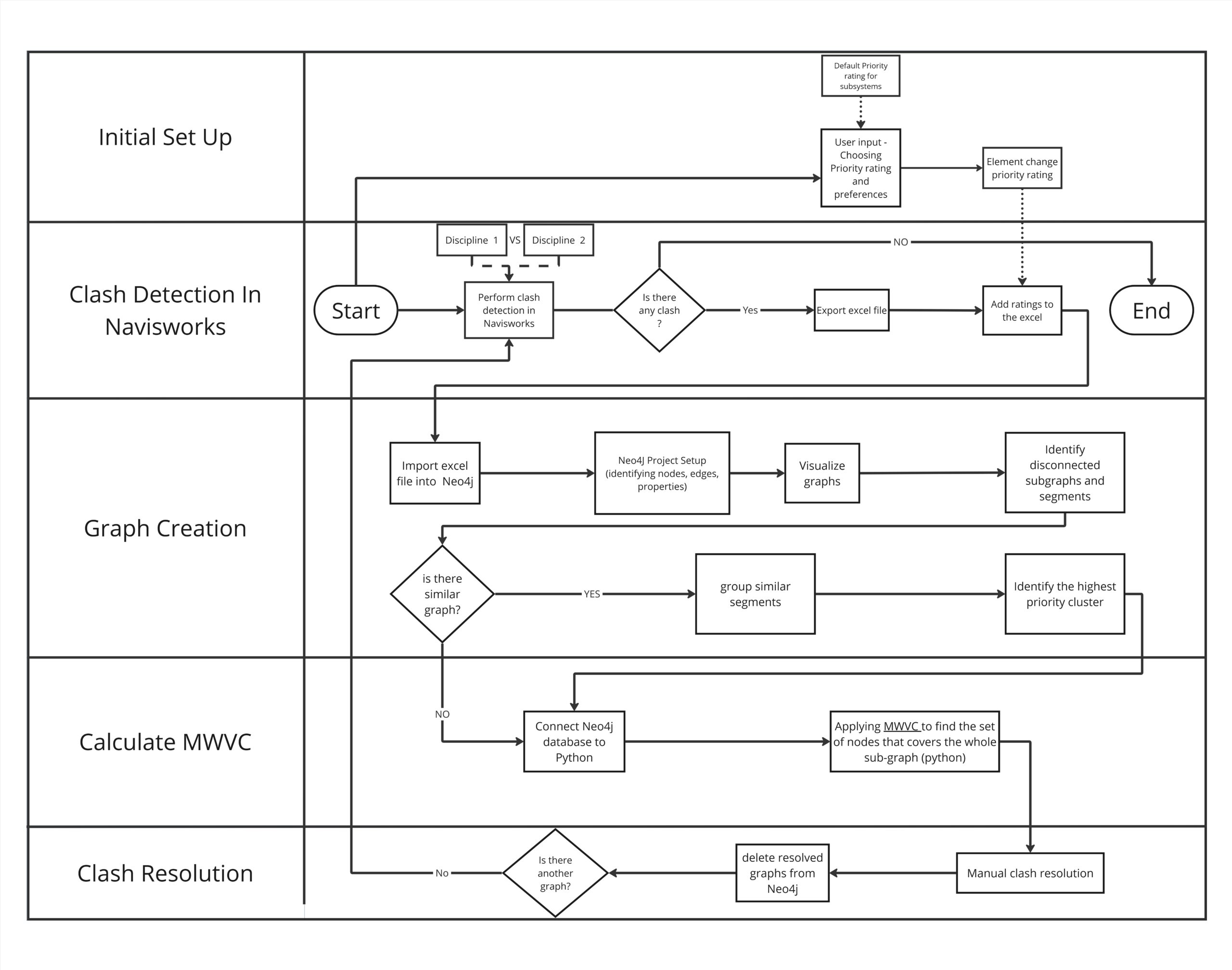
Results show that representing clashes as graphs, where components are modeled as nodes and clashes as edges, captures their interdependencies rather than treating each clash as an isolated issue. This approach enabled the automatic grouping of related clashes based on their shared components. The findings also demonstrate that integrating component priority rankings into the analysis provides a way to identify the most flexible components within each clash group. In many cases, the proposed system identified a single component or a set of components whose modification could reduce multiple related clashes simultaneously. The case studies further confirm that the proposed system integrates into existing coordination workflows by using standard clash detection outputs from Navisworks and transforming them into a graph for analysis.
This research makes two contributions:
1.Practical Contribution: By semi-automating repetitive analytical tasks, the proposed system reduces manual effort and enhances the reliability of coordination outcomes.
2. Theoretical Contribution: The work expands the application of graph theory in construction engineering, demonstrating its ability to capture and analyze interdependent relationships within building systems and to serve as a foundation for optimization decision support.